Slope analysis
DEMs allow the calculation of terrain slope at every point on the map, providing essential information for evaluating the difficulty of a route.
Areas with steep slopes may indicate challenging sections, technical passages or potentially dangerous areas in the presence of snow or unstable terrain.
DEM-based analysis is particularly useful when the elevations recorded by a GPS receiver are affected by altitude errors, as explained in the article GPS Accuracy: Errors, Precision, and Signal Limitations.
Slope exposure
Aspect indicates the orientation of the terrain with respect to the cardinal directions and is one of the analyses that can be obtained from a Digital Elevation Model (DEM).
This information is very useful for evaluating sunlight exposure, presence of residual snow, terrain moisture and microclimatic conditions.
Ridges and drainage lines
DEMs make it possible to automatically identify mountain ridges, watersheds and drainage lines, which are the natural water flow paths.
These morphological structures are important for planning safe routes and understanding the shape of the terrain.
Technical route evaluation
By combining slope data, elevation gain, exposure and terrain morphology it is possible to estimate the technical difficulty of a route.
These analyses are particularly useful for advanced hiking, mountaineering, mountain biking and planning complex traverses.
Terrain analysis with OkMap
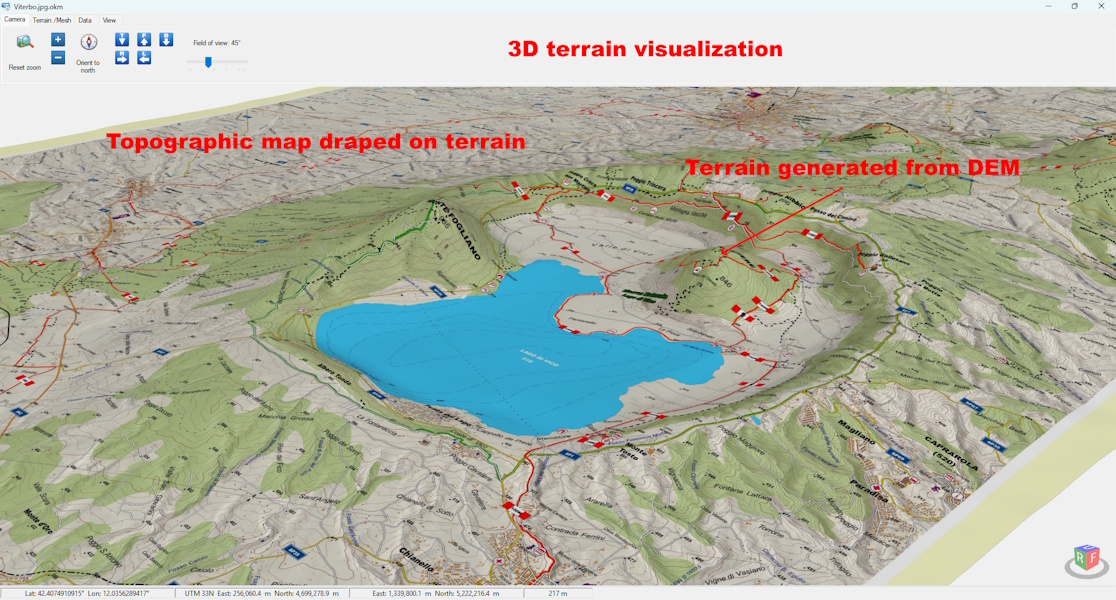
OkMap integrates Digital Elevation Models (DEMs) with raster maps, GPX tracks, and waypoints, allowing you to visualize the terrain in three dimensions and analyze its morphology from virtually any viewpoint.
This integration makes it possible to study the terrain directly on the map, making route planning easier and helping you assess the area's topographic characteristics.
OkMap can also derive advanced information from DEM data, including slope maps, terrain aspect, hillshade maps, and three-dimensional visualizations for detailed terrain analysis.
Practical applications in hiking
Terrain analysis through DEMs helps choose safer routes, evaluate alternatives and predict possible difficulties along the route.
These tools are also useful for estimating travel times, physical effort and environmental conditions along the route.