What DEMs are
A DEM is a grid of numerical data that describes the terrain elevation at specific geographic coordinates.
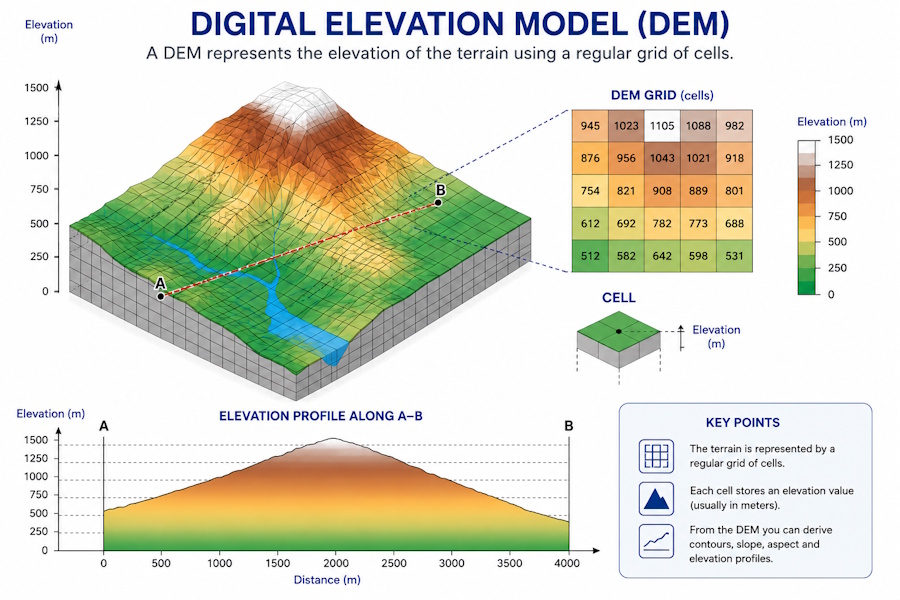
Each cell in the model contains an elevation value, allowing the terrain shape to be digitally reconstructed.
Why DEMs are important
Elevations recorded by GPS receivers are often less accurate than horizontal coordinates.
Using DEMs makes it possible to correct GPS elevations, improve elevation profiles and obtain more realistic elevation gain values.
DEM and GPX track analysis
Digital Elevation Models are used to analyze GPX tracks, calculate ascents and descents and generate detailed elevation profiles.
These data are particularly useful for trekking, mountain biking, mountaineering and outdoor planning. For planning your routes, you may also find the article How to Plan GPX Routes for Hiking helpful.
DEM resolution and accuracy
The quality of a DEM mainly depends on its spatial resolution, that is, the distance between grid cells.
High-resolution DEMs allow more detailed analysis, but require more storage space and processing power.
To use a DEM correctly, it is also important that the data be associated with the correct coordinate system, so as to avoid misalignments with maps and GPS tracks.
Types of DEM data
DEMs can be derived from satellite surveys, radar, aerial photogrammetry or LIDAR scans. Among the most widely used datasets are SRTM, Copernicus DEM, ASTER and local LIDAR data. The choice of the most suitable model depends on geographic coverage, resolution, data quality and the type of analysis to be performed. For a comparison of the main datasets and to understand which DEM to use in different situations, see the article SRTM, Copernicus and Other DEMs: Which One to Choose?.
Using DEMs with OkMap
OkMap uses DEM data not only to display terrain elevations, but also to improve the accuracy of elevation analyses. GPS elevations can be replaced or corrected using values from the Digital Elevation Model, making it possible to obtain more reliable elevation profiles and elevation gain statistics.
OkMap allows you to load and use DEM data to correct GPS elevations, calculate elevation profiles and obtain detailed route statistics.
The software also allows integration of DEMs with raster maps and GPX tracks, improving the accuracy and quality of outdoor analyses.